

In their early stages, proposed developments are full of promise. But before that promise is fulfilled, projects need to consider the impact that the development may have on the surrounding transportation network. In Montgomery County, Maryland, the Local Area Transportation Review (LATR) process evaluates whether transportation facilities can adequately support a proposed development and identifies improvements or mitigation that may be needed.
For developers, property owners, and even their design teams, the LATR can have practical implications for project planning, costs, and approvals. This article explains the basic study requirement and what the LATR review considers. We hope it helps your team anticipate transportation issues before important project decisions are settled.
What Determines Whether an LATR Study Is Required?
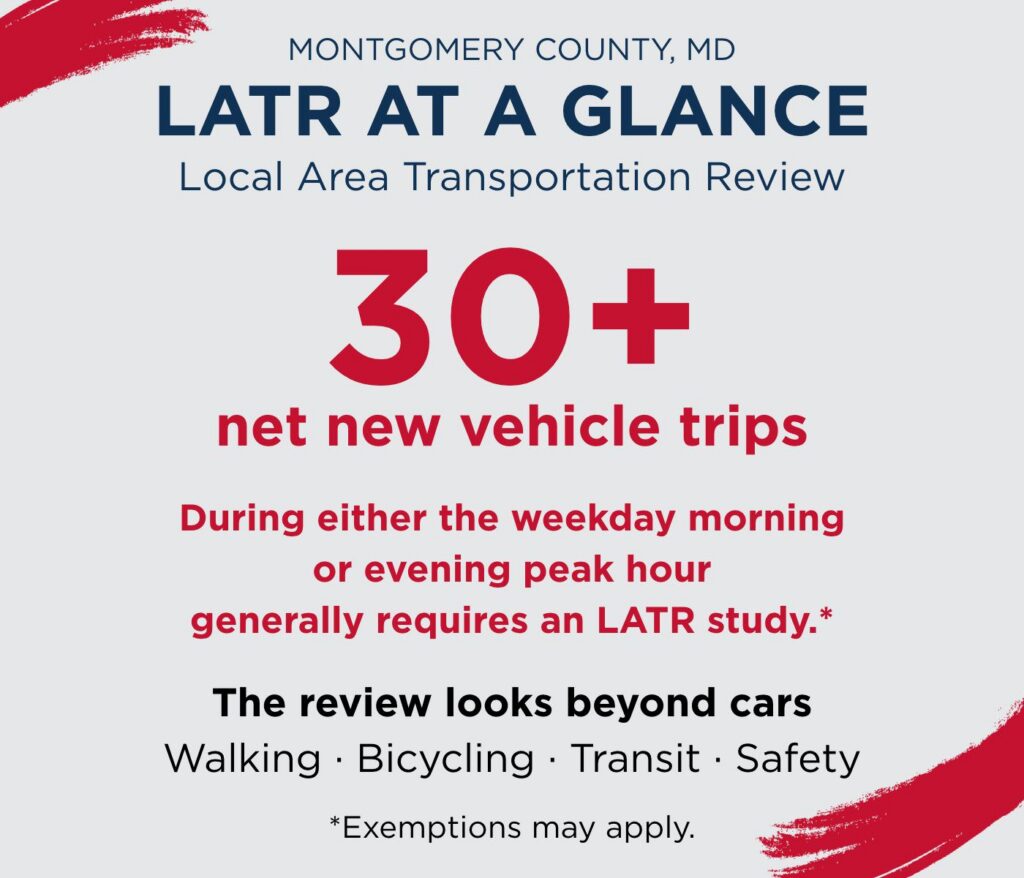
Under Montgomery County’s current LATR guidelines, a proposed development generally requires a study if it will generate 30 or more net new motor vehicle trips during either the weekday morning or evening peak hour, unless an exemption applies.
To understand what that means for a particular property, it helps to understand how trips are counted.
Understanding Trips and the 30-Trip Threshold
A “vehicle trip” is one movement into or out of a property. For example, a car arriving counts as one trip. That very same car leaving counts as another trip.
The “30-trip threshold” in the LATR guidelines relates to activity during a single peak hour, rather than the total number of vehicles visiting over an entire day. The morning and evening peak hours are evaluated separately, and reaching the 30-trip threshold in either one can trigger the study requirement.
In the LATR guidelines document we linked to above, which was last updated in September 2026, it states: “The updated policy requires a study for a proposed development generating 30 or more net new peak-hour weekday motor vehicle trips, unless otherwise exempt.”
In that quote, “net new” means the additional trips attributed to the proposed development after subtracting trips associated with an eligible existing or former use of the property. Those subtracted trips are called “trip credits.” They recognize that a property being redeveloped may already have generated traffic.
It may help to understand this using a simplified example. Let’s suppose a proposed development is estimated to generate 70 vehicle trips during the weekday evening peak hour, after applicable county adjustments. If the use it replaces qualifies for 25 trip credits during that same hour, the result is 45 net new trips: 70 minus 25. That exceeds the standard 30-trip threshold.
You can see that the arithmetic here is pretty straightforward, but establishing these numbers actually takes some work. A transportation consultant estimates trips based on the proposed uses and development size, applies the county’s relevant adjustments, and documents any eligible trip credits.
Some projects qualify for exemptions from all or part of the LATR study requirements. However, we won’t cover those exemptions in this article. We will plan to take a closer look at those exemptions in a future article. In the meantime, you can contact us if you have questions about how an exemption might apply to your project.
Note: Even though a project may generate fewer than 30 net new peak hour trips, MCDOT or SHA can request that operational analyses be provided to ensure that adequate operations are maintained.
Confirming the Study Requirements: The Transportation Adequacy Form
Montgomery County’s Transportation Adequacy Form records the proposed development and trip estimates, confirms whether a study is required, and establishes the scope of the analysis with the reviewing agencies.
Montgomery Planning requires the form to be submitted for review and approval before an LATR study begins or before a development application requiring an Adequate Public Facilities finding is filed. That finding is the county’s determination that public facilities can adequately support the development.
After the Transportation Adequacy Form is approved, you have 12 months to file a complete application. You have to resubmit if that lapses or the proposal changes significantly. Montgomery Planning’s Transportation Development Review resources include the form, current guidelines, and supporting materials.
Under Montgomery County’s current LATR guidelines, a proposed development generally requires a study if it will generate 30 or more net new motor vehicle trips during either the weekday morning or evening peak hour, unless an exemption applies.
What Does an LATR Study Evaluate?
An LATR study evaluates whether the surrounding transportation network can support the proposed development. Depending on the applicable requirements, the review can encompass many aspects, including:
- Roadway speeds*
- Intersection operations
- Site driveways
- pedestrian comfort
- accessibility
- streetlighting
- bicycle conditions, and
- bus transit amenities
The study also includes a Vision Zero statement, which addresses roadway speeds and safety. If the study identifies inadequate conditions, it determines the improvements or payments needed to address them.
*Note: The Vision Zero statement requires 48-hour speed studies taken mid-week, while school is in session, in dry weather. The number of studies goes from 1 to 4 as trip volume rises. Keep this scheduling in mind for summer filings.
The breadth of the LATR study is important for developers to understand. In line with modern transportation analyses, a project’s transportation considerations can extend well beyond how many additional single-occupancy vehicles will pass through a nearby intersection.
As an example, our work on Marriott International’s headquarters and flagship hotel in downtown Bethesda included a multimodal LATR study that examined surrounding intersections and corridors, along with pedestrian, bicycle, and transit systems.
Streetlighting may also be an issue that deserves attention during project planning. Our article on streetlight and illuminance updates to Montgomery County’s LATR guidelines explains this aspect of transportation review in greater detail.
Looking Beyond Intersection Capacity
Even when nearby intersections can handle the additional traffic, an LATR study may identify other improvements that are needed.
For example, at Heritage Gardens, a residential care community in Potomac, our LATR study concluded that adjacent intersections would operate adequately during peak hours. However, pedestrian comfort and bicycle traffic stress conditions required mitigation.
Address Transportation Issues Before the Project’s Layout Is Settled
Access, parking, loading, pedestrian connections, and the surrounding street network deserve consideration while the design team still has flexibility.
For example, our work on Lot 31 in downtown Bethesda illustrates how these issues can come together. The mixed-use redevelopment included residential buildings, retail space, and a public parking garage. Alongside the LATR, our team evaluated garage driveway operations, nearby intersections, pedestrian safety improvements, traffic signal options, and neighborhood protection measures.
Contact our Maryland Traffic Engineering Team

Kelly Caponera, P.E., PTOE
Senior Associate | (703) 917-6620
kmcaponera@wellsandassociates.com
Kelly Caponera, P.E., PTOE is a traffic engineer with extensive experience in transportation safety and planning. She has worked as a consultant and project manager with both public and private sector clients, addressing traffic-related challenges on residential, commercial, institutional, and industrial projects.

Michael J. Workosky
President | (703) 676-3603
mjworkosky@wellsandassociates.com
Mike Workosky is a transportation executive with more than 25 years of experience across the United States in parking matters related to mixed use developments, town centers, shopping centers, and commercial, governmental, and academic properties.