
In the 2000s, my family relocated from Fredericksburg, Virginia to Mecklenburg County, North Carolina. We lived roughly ten miles from Charlotte city limits, in the Town of Cornelius. I was excited to be so close to the city which felt like it would bring more things to do and see as a teenager. However, even then I found that we would plan our days around traffic and parking any time we went into uptown, if we didn’t avoid the trip entirely.
After moving off to college and then to DC in the early 2010s, coming home without a vehicle proved to be problematic. To enjoy the city, I’d need multiple types of transit passes and again would find myself planning my day around how I could make simple trips.
Fast forward to today, not only am I able to enjoy the 77x express bus from Cornelius to Uptown – cutting my commute by 10-20 minutes one-way compared to driving alone – but I can also now be picked up at my house by CATS microtransit to get to the Park and Ride. The feeling of being “stranded” that I had in the previous decade is a distant memory.
“With 157 people moving to the Charlotte region every day, developers and property owners have to consider not only how people will park their cars, but also how they’ll reach their site by biking, by transit, or other modes of transportation.”
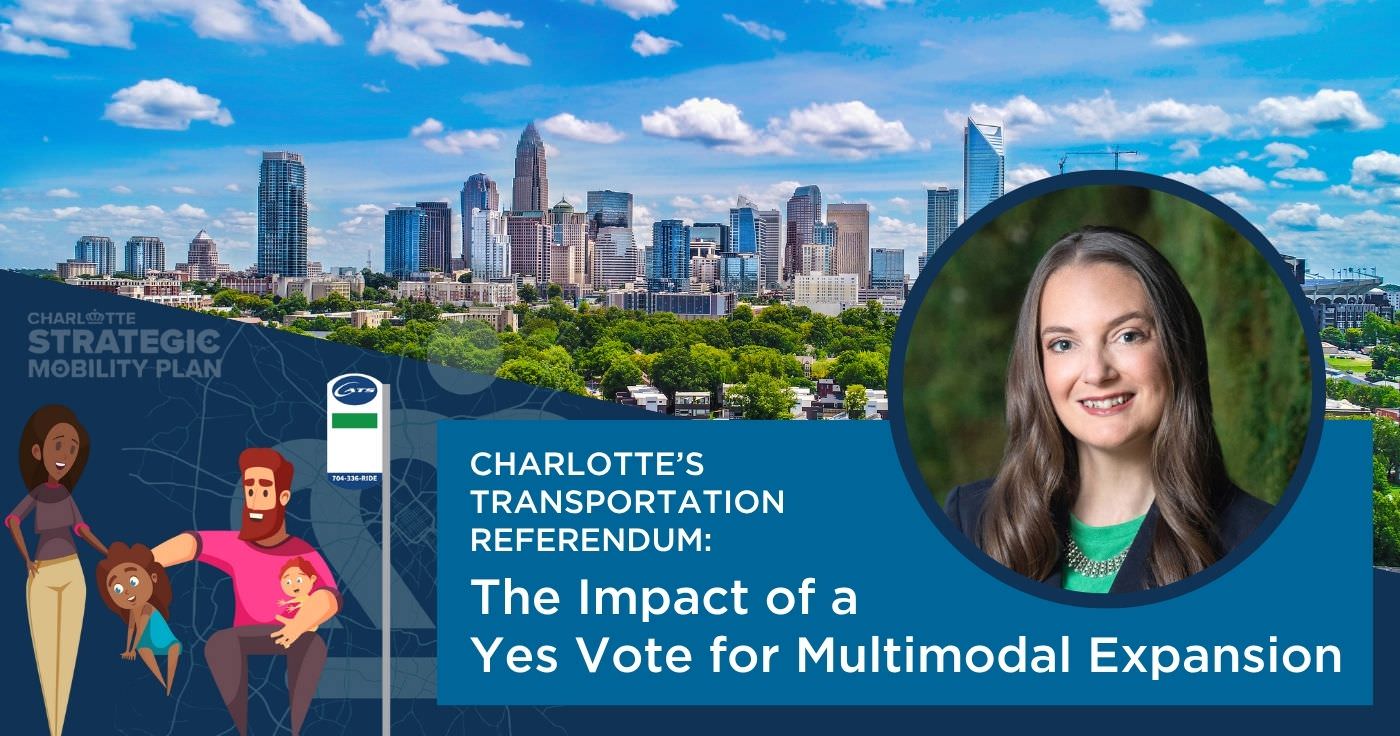
Charlotte’s passage of the 1% tax increase to fund a comprehensive transportation plan ensures that the progress that’s been made over the past 20 years is catapulted forward. Generating approximately $19.4 billion in transportation improvements over the next 30 years, this allows more trips that were once deemed impossible or impractical to be made easily and conveniently without having to plan your whole day around traffic, parking, or complicated schedules, providing more access to communities, workplaces, shopping, dining, and events.
This funding helps realize Charlotte’s 30-Year Strategic Mobility Plan which identified 22 strategic investment areas across Mecklenburg County and projects that would result in:
- 264 miles of road widenings, complete streets, sidewalks, and bicycle facilities
- 95 intersection improvements
- 41 new traffic signals
- 60 miles of shared use path
- 45 mobility hubs
- 15 microtransit zones
The funding also expands rail, realizing projects like the Red Line commuter rail, and increases bus frequency, which encompasses 60% of the CATS system’s total ridership.
“Generating approximately $19.4 billion in transportation improvements over the next 30 years, this allows more trips that were once deemed impossible or impractical to be made easily and conveniently without having to plan your whole day around traffic, parking, or complicated schedules.”
Just this week, I attended the 82 Alliance conference in Nashville, TN, which focused on reimagining mobility and how people move through our communities. Hearing from cities like Nashville, Columbus, and Austin which have passed similar measures, a few elements that will be important as these plans move forward include:
- Strong leadership: To ensure the funds committed serve the vision and plan and are upheld and executed
- Continued community engagement and commitment: To ensure community members continue to see themselves in the plan and when changes may be realized
- Partnerships: To help deliver wins faster and support continued engagement
As part of the passage, a new governance structure, the Metropolitan Public Transportation Authority (MPTA), will be formed to oversee transit across Mecklenburg County, with the goal of realizing a more connected region.
For the development community, there’s an opportunity to ensure that what we build leverages these investments so that the people who ultimately live, work, and play at our sites have options and can make choices about how they move around in their daily lives, rather than feeling confined by not having a car or by having a car as their only option.
With 157 people moving to the Charlotte region every day, developers and property owners have to consider not only how people will park their cars, but also how they’ll reach their site by biking, by transit, or other modes of transportation, to meet the shifting needs and desires within our community and so that more people doesn’t have to mean more traffic – improving the experience for everyone.
To quote the former mayor of Austin, Steve Adler, who addressed the audience at the 82 Alliance conference this week as the keynote speaker, now may be the time to “be a little more afraid of doing too little than you are of doing too much.”